
copyright

David vs. Goliath in Pandora: Did Hollywood Steal "Avatar"?

David vs. Goliath in Pandora: Did Hollywood Steal “Avatar”?

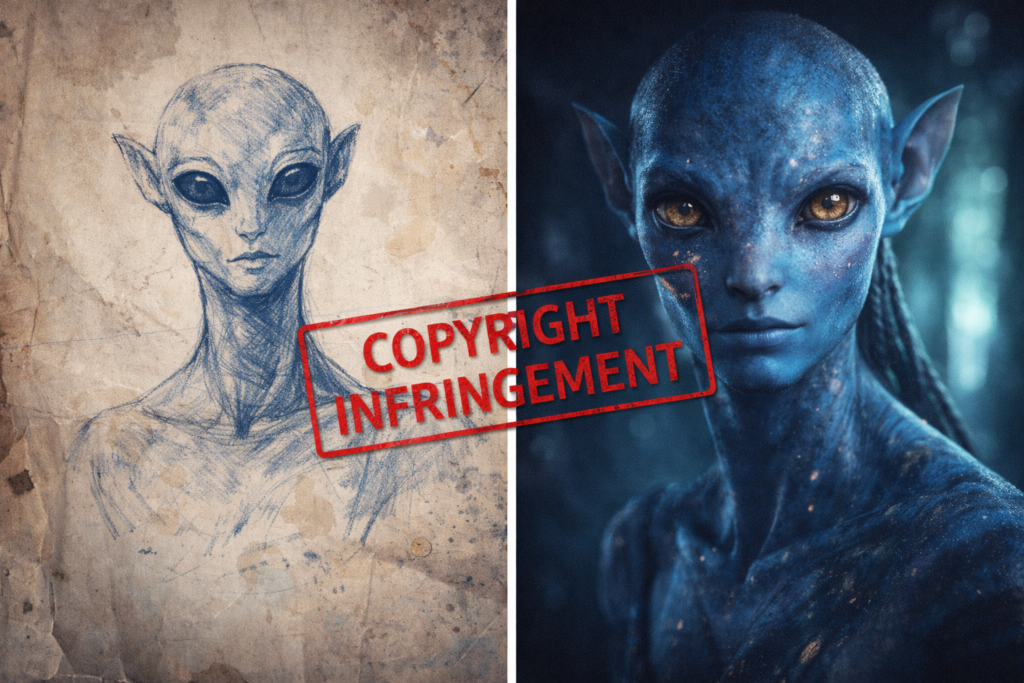
David vs. Goliath in Pandora: Did Hollywood Steal “Avatar”? back to blog The “Avatar” Theft Accusation Imagine spending years building a universe—sketching the creatures, writing the lore, breathing life into a story only you know. Then, years later, you walk into a movie theater and see your exact imagination on the biggest screen in the world… with someone else’s name on it. This nightmare scenario is exactly what a former 3D animator claims happened to him, and in December 2025, he finally took the biggest director in history to court. The Story: On December 15, 2025, a massive copyright infringement lawsuit was filed in Los Angeles against James Cameron, Lightstorm Entertainment, and Disney. The plaintiff? Eric Ryder, an independent creator and former animator. Ryder alleges that decades ago, he spent two years developing a sci-fi epic called “KRZ”. His story featured: Anthropomorphic beings living on a lush moon of a gas giant. A sinister, Earth-based corporation mining the moon for resources. A profound environmental theme connecting the natives to their land. Sound familiar? It’s the exact plot of Avatar. Ryder claims he pitched “KRZ” to Lightstorm Entertainment in the late 90s. He says executives worked with him, reviewed his extensive concept art and 3D models, and then… ghosted him. They allegedly told him “no one would watch an environmental sci-fi movie.” Years later, Cameron released Avatar, which went on to become the highest-grossing film of all time. Ryder is now seeking damages for what he calls the “unauthorized plundering” of his life’s work. The timing is critical—the lawsuit targets the massive profits from the recent sequel, The Way of Water. The Lesson: This case highlights the most dangerous trap in the creative industry: The Pitch Meeting. Ideas are fragile. Without a paper trail, a registration, or a clear contract, your “great idea” is just free inspiration for someone with a bigger budget. How ASEAN IPR Helps: You don’t need to be James Cameron to face an IP theft suit—or to be the victim of one. Whether you are a startup pitching to investors or a studio receiving scripts, you need protection before you enter the room. At ASEAN IPR, we build the shield around your ideas: Idea Submission Protocols: We draft legal frameworks for receiving or pitching creative concepts, ensuring non-disclosure and non-use are legally binding. Timestamped Registration: We handle copyright registration before your pitch, giving you irrefutable government-backed proof of ownership. Chain of Title Review: We trace the ownership history of your assets to ensure no former freelancer or “ghosted” creator can come back to claim your profits years later. Protect Your Creative Assets Other Articles October 2025: The Day Adidas Lost Its Stripes in London • December 9, 2025 • trademark this is the news for trademark blog section for the October month 2025 November 2025: Can an AI Own a Brand? The Ruling That Changed Everything • December 18, 2025 • trademark Can an AI Own a Brand? The Ruling That Changed Everything back to blog The “AI-Generated” Trademark Trap Imagine you spend six … The Billion-Dollar Bumper Case That Changed Repair Rights • December 10, 2025 • industrial design The Billion-Dollar Bumper Case That Changed Repair Rights back to blog The “Must Match” Verdict For decades, car manufacturers have held a … Who Owns the “Swipe”? The GUI Design Battle • December 18, 2025 • industrial design Who Owns the “Swipe”? The GUI Design Battle back to blog The “Smart Interface” War  In the physical world, an industrial design …

David vs. Goliath in Pandora: Did Hollywood Steal “Avatar”? Read More »

A conceptual 3D illustration of a glowing, transparent artificial intelligence brain inside a glass box that is being shattered by a golden judge's gavel. Inside the brain, you can see fragments of musical notes and text lyrics floating. The background is a dark, matrix-style digital void. High contrast, cinematic lighting.

The Day the Music Stopped for AI: German Court Crushes OpenAI’s “Training” Defense

The Day the Music Stopped for AI: German Court Crushes OpenAI’s “Training” Defense back to blog The AI “Black Box” Defense is Dead For years, AI giants have relied on a single, powerful argument: “Our models don’t copy your work; they just learn from it like a student reading a book.” It was the perfect “Black Box” defense—too complex to disprove and too vague to regulate. But in November 2025, a court in Munich didn’t just crack that box open; they smashed it to pieces. If you use AI to generate content, the legal safety net you thought you had might have just vanished. The Story: In a landmark ruling that shook the tech world, the Regional Court of Munich ruled in favor of GEMA (a German music rights organization) against OpenAI. The dispute wasn’t about the AI generating a perfect copy of a song; it was about the process itself. GEMA proved that ChatGPT had “memorized” copyrighted song lyrics and could regurgitate them when prompted. OpenAI argued that this was merely “statistical probability”—that the AI was just guessing the next word, not copying the text. The court disagreed. They ruled that “memorization” equals “reproduction.” This is a massive shift. It means that simply holding copyrighted data in a model’s “weights” (its long-term memory) can be considered copyright infringement, even if the AI never outputs the full song to a user. It effectively kills the “fair use” argument that AI companies have been hiding behind for years. The Bigger Picture: This isn’t just about lyrics. This precedent threatens the foundation of every Large Language Model (LLM) built on scraped data. We are already seeing the domino effect: Anthropic (creators of Claude) rushing to settle a similar lawsuit for $1.5 billion in September 2025 to avoid a similar verdict. Warner Music Group striking emergency licensing deals with AI music generators like Udio and Suno in November 2025. The message is clear: The era of “move fast and break things” is over. The era of “pay for what you use” has begun. How ASEAN IPR Helps: If your company uses Generative AI for marketing, code, or design, are you inadvertently infringing on a copyright holder’s “reproduction” rights? The legal landscape is shifting beneath your feet. At ASEAN IPR, we future-proof your innovation: AI Vendor Audits: We review the “Terms of Service” and indemnity clauses of the AI tools you use, ensuring you aren’t liable for their “training” data. Copyright Registration for Hybrid Works: We help you navigate the complex new rules on registering content that is partially human-made and partially AI-generated. Risk Assessment: We provide a “Copyright Health Check” to ensure your internal datasets don’t violate the new “memorization” precedents set by global courts. Secure Your Content Strategy Today Other Articles October 2025: The Day Adidas Lost Its Stripes in London • December 9, 2025 • trademark this is the news for trademark blog section for the October month 2025 November 2025: Can an AI Own a Brand? The Ruling That Changed Everything • December 18, 2025 • trademark Can an AI Own a Brand? The Ruling That Changed Everything back to blog The “AI-Generated” Trademark Trap Imagine you spend six … Who Owns the “Swipe”? The GUI Design Battle • December 18, 2025 • industrial design Who Owns the “Swipe”? The GUI Design Battle back to blog The “Smart Interface” War  In the physical world, an industrial design … The Billion-Dollar Bumper Case That Changed Repair Rights • December 10, 2025 • industrial design The Billion-Dollar Bumper Case That Changed Repair Rights back to blog The “Must Match” Verdict For decades, car manufacturers have held a …

The Day the Music Stopped for AI: German Court Crushes OpenAI’s “Training” Defense Read More »