Stopping Fakes at the Border: Myanmar’s New Customs Recordation Rules

Category: Customs Recordation

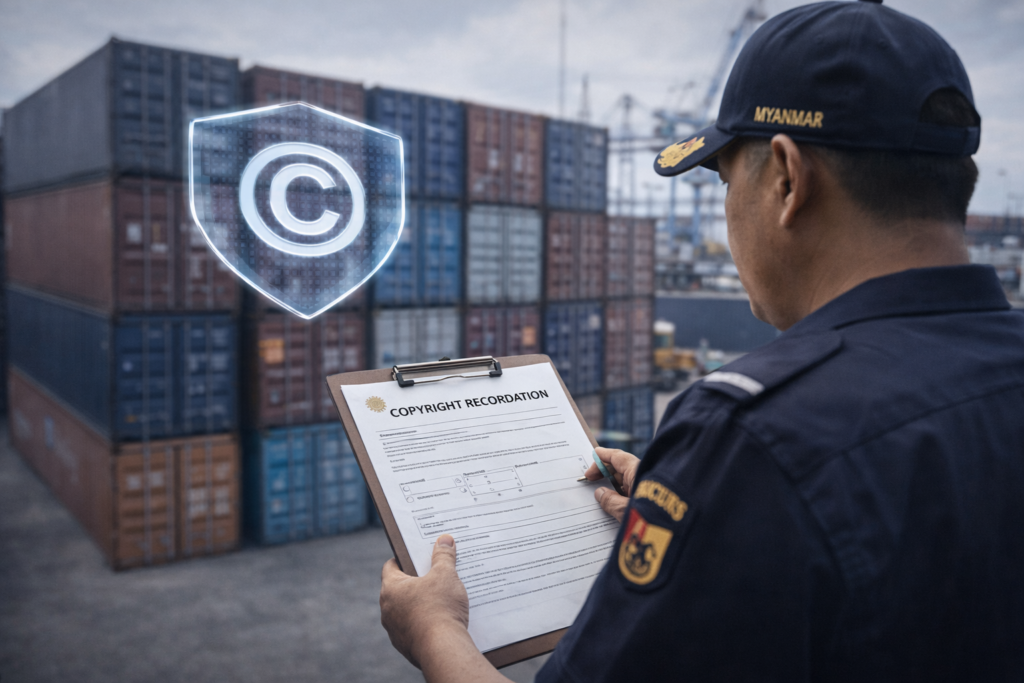
Ultra-realistic documentary-style photograph of stacked shipping containers at Yangon Port, arranged in clean industrial rows under natural daylight. A subtle digital overlay of a transparent shield icon is superimposed over the containers, symbolizing copyright protection and border enforcement without overpowering the scene. In the foreground, a Myanmar customs officer in official attire is holding a clipboard with a clearly visible form titled “COPYRIGHT RECORDATION”, reinforcing formal legal procedure and compliance. The officer’s posture is professional and focused, suggesting active inspection and enforcement. Background elements include cranes, port infrastructure, and logistics equipment, softly blurred to maintain depth and realism. Serious operational tone; neutral industrial color palette with restrained blue highlights from the digital shield; shallow depth of field; high resolution; photojournalistic editorial style suitable for IP recordation, customs enforcement, and anti-counterfeiting policy coverage.

Sources:

  • Myanmar Sets Customs Recordation Rules (Tilleke & Gibbins, 2025)

Introduction Enforcement in Myanmar has often been challenging, but 2025 brings a powerful new tool for rights holders. The Ministry of Planning and Finance has issued Notification 107/2025, establishing the official procedures for Customs Recordation of Copyrights and Trademarks.


How It Works Under the new system, IP owners can register their rights directly with the Customs Department. This creates a “watch list” for customs officers. If a shipment of suspected counterfeit goods is detected, officers can now detain the goods and notify the rights holder, who then has a fixed window (typically 10-15 days) to inspect the goods and initiate legal action.


A Shift to Proactive Enforcement Previously, stopping counterfeits at the border required specific court orders for every shipment. This new “Recordation” system allows for ex officio action—meaning customs can act on their own initiative based on your recordal, drastically reducing the reaction time needed to stop fakes from entering the market.

How ASEAN IPR Helps: Don’t wait for fakes to hit the streets of Yangon. ASEAN IPR manages the administrative process of Customs Recordation. We submit the required “Form 1” to the Customs Department and provide training guides to officers, teaching them how to spot fake versions of your specific products.

Other Blogs

The Design Revolution: How Thailand's New Grace Period Protects Your Creativity

The Design Revolution: How Thailand’s New Grace Period Protects Your Creativity back to blog Category: Industrial Design Strategy Sources:Thailand’s Draft Industrial Design …

April 1, 2025: The Day European Patents Became Valid in Laos

April 1, 2025: The Day European Patents Became Valid in Laos back to blog Category: European Patent Validation Sources: Launch of the …

Thailand's New Patent Draft Act: Green Innovation Gets the Fast Lane

Thailand’s New Patent Draft Act: Green Innovation Gets the Fast Lane back to blog Category: Patent Law Reform Sources: Updates on the …

Taking Down the Digital Fakes: IPOPHL's New Strategy for Online IP Enforcement

Taking Down the Digital Fakes: IPOPHL’s New Strategy for Online IP Enforcement back to blog Category: Online & E-commerce Enforcement Sources: Counterfeit …